Wednesday, 25 August 2010

publishing water colour painting "Golden Days"


"Golden Days" published on the 13th of August in celebration of my parents Golden Wedding.


How was this composition inspired?

It was in fact late May and I was observing the two swans nests as it was imminently time for the eggs to hatch.

I was particularly interested in the nest under the coniferous tree in Roath Park and was sitting with my pastills painting what I had given the pet name "The Forest Swans Nest". It was the second year the pair had nested under the tree and it was exciting because the nest was so close to passing visitors to the park ... although many did not spot the nest!


The forest swans nest with her five eggs under the tree close to the lake. She regularly left the nest to go and dip in the water. To me it seemed a great risk the eggs were so close to the passing inquisitive public.


The events shown in the watercolour composition above all happened as I sat on the bank of the lake painting, my position being midway between the willow, where the Great Crested Grebes were sitting on the nest.


Here are a couple of sketches


It has fascinating to watch the Grebes this year, there have been many pairs successfully breeding particularly at Roath, as can be seen from the slide show of a boat trip we took on the lake in early July.

While many were sitting on their first clutch of eggs in July, the same pair who appear in the painting had adopted a different willow and were sitting on their second clutch of eggs.


Most of these pairs have now successfully hatched and to a large extent are having success bringing up their broods, with few losses.


Here can be seen the same pair of grebes with their second clutch of five chicks clearly seen as the blustery August wind, and portrayed in the lower sketch on the right.


The upper sketch shows a grebe sitting high on a nest, under the original willow where the above pair had their first nest. It is quite interesting to see the pair making a nest high above the water resembling that of a coots nest site rather than the floating nest at water level that grebes tend to make.
It will be interesting to see if this latest pair in fact are successful with their clutch of eggs ... it is quite late in the season and the weather has changed dramatically from the bright days of the early summer.
Have you spotted the young coot looking on also sharing the willow with the grebes?


Monday, 9 August 2010

Returning to Blaenau Gwent for the Eisteddfod 2010


Can the arts influence development?


I have to remark in the five years that I drove up from Newport to Abertillery (2003-8) there was never a sign welcoming the traveller into the county... so when I made a visit in May I could not help noticing the new sign indicating the forth coming visit of the Eisteddfod to Ebbw Vale.


For much of my time, between 2003-8 working Blaenau Gwent in the promotion of both healthy foods and the environment with communities the project developed and participated in many arts projects. The above is the Environmental Community Canvass which had involved working with 6 communities and culminated in the painting of 6 Canvass which were displayed in various locations in the county to promote the project and work of BTCV Cymru. The Canvass can be seen here on display at Brynbach Park.


In coming up this August I was interested in seeing both the Eisteddfod, but also the Six Bells Miners Memorial.


The Eisteddfod Ebbw Vale 2010


The Eisteddfod is a national annual event which takes place in different parts of Wales. The last time the Eisteddfod was in Ebbw Vale was in 1958.

The purpose of the gathering is in the promotion of welsh culture and language and there are many competitions throughout the week in many categories from poetry recital to folk dancing.

This picture shows one of the Men's choirs competing for the cup that is the foreground against two other choirs in the same category.


All ages are encouraged to take part, here is a group of young people from Cardiff who are learning to play the harp and were able to have the experience of competing on the Eisteddfod stage.
They played very well and came second in their category.


Another very interesting part of the Eisteddfod was the arts show, at Ebbw Vale it was housed in an underground concrete tank, formerly part of the the old steelworks that had been on the site.
One could not help making some comparisons of the choice of Gallery site to the New Tate Gallery in London. During the week on the television news it was suggested that the site may become a permanent gallery.


The old Steelworks site for the Eisteddfod for a week and there are questions now being raised as to whether the Gallery could become a permanent fixture on the Welsh Map.

There was much interesting work on display from experiments with light using every day objects such as shoe laces winning the fine art prize, to very colourful paintings of views of Ebbw Vale in the free art section.
There were quite a number of provoking pieces of work including these two pieces:


Rebellious House / Bandage
by Ifor Davies


The Lost World
By Geraint Evans


Both quite thought provoking images in a world that is ever changing!
I must admit listening to the singing of choirs was much more relaxing than considering what the message these artists were possibly conveying.

Six Bells and the Six Bells Miners Memorial


Here is another piece of artwork to be found in Six Bells .
It was painted on a bridge underpass as part of a summer community arts project in 2006, and was facilitated by the Six Bells Regeneration board. At the time the older members of our project worked alongside the children on their summer holidays.
It worked well with our older participants working on the detail of the miners lamp and the younger artists working on less detailed areas.
The work depicted the old and new that of the old mines that Six Bells is known for, to the pleasant environmental features that have now replaced that industrial period.
Some four years later it is good to find the art work still in good shape
The project


It is good to see that new initiatives are still being born in Six Bells.
Mike Crake who did much to help facilitate the BTCV project while it was developing was also part of the Six Bells Regeneration Board and has remained part of that board since.
They have as a result of consultation with the local community built a new bridge facility over the Ebbw Fach river that flows through Six Bells and has improved communication in the community. To name but one project.
Most recently the Partnership overseen by Communities First was keen to create a fitting new memorial to reflect the loss of 46 lives in the Six Bells mining disaster of June 1960.


The result has been the construction of this steel miner which is on a Parr with the "Angel of the North" and was designed by a local Welsh artist
Sebastien Boyesen.
The completed structure, the arms were only recently added can be seen here dominating the whole of the Six Bells valley and is built on the former colliery site.


Those who have commissioned (Communites First and Blaenau Gwent County Council) the design anticipate it being a new Welsh Landmark.
Lets hope this piece of art while reminding the community of a tragic time in the communities history will also be a focal point for the future.


Sunday, 25 July 2010

Summer Behaviour at the Lake.

This picture taken in early June shows the family of four signets becoming instant attractions to the boating public in their first week on the lake after hatching.


This is the only family to successfully hatch and have signets on the lake. I think it is the only time in the time i have been following the swans at Roath that there has only been one family group.


Does anyone know has it been a poor year for swans in other places too?


I and some friends went out in a rowing boat earlier this month to view activities on the lake ... we discovered several grebes nests as the slide show on the right shows.


...... lets now look and see how life has progressed on the lake since as the summer quickly passes!


In foreground of the above picture can be seen a late coots nest built out into the water, with the coot sitting on the eggs.


This picture shows the same nest this week with one of the young coots on the nest. Young coots seem to keep a link with the family nest for quite sometime. This is the case until the adult coots take over the nest to incubate another clutch of eggs.


It will be interesting to see if this nest in fact has a second clutch of eggs.


Life round the Islands:


I painted this portrayal of the waters round the islands early this morning before the park became busy with the Sunday crowds. It is very clear that their is a fine balance in the park as i the summer months the park sees much activity with people and wildlife must take to the foliage of the islands and the protection of the above tree canopy .... but there is much activity of many kinds while the park is relatively quiet in the early morning.


In the background of the painting can be seen a family of grebes, the second to hatch here in the park. They nested under the protection of the foliage of the islands and four chicks were hatched nearly a fortnight ago. In the picture (left) the four chicks can be seen quite clearly with one of the grebes. The other will be away getting food and comes to the family underwater to hide their location, Four is a large number for grebes and will require much hunting by the adult grebes, Periodically gulls swooped above a reminder of the vulnerability of these chicks at this stage.


In the foreground of the painting can be seen the fast growing signets who seem to get escorted with one parent ahead and the other bringing up the rear in a convoy as they come up from their roosting area to dabble on the young fresh reed to be found up here.


Here too coots dive and there is the odd stand off over territory as coots ruffle up their plumage to defend their Territory's as the coot is depicted doing in the centre of the painting. On occasion they will fight. Alsol note the fast changing flora as summer progresses.


Geese behaviour


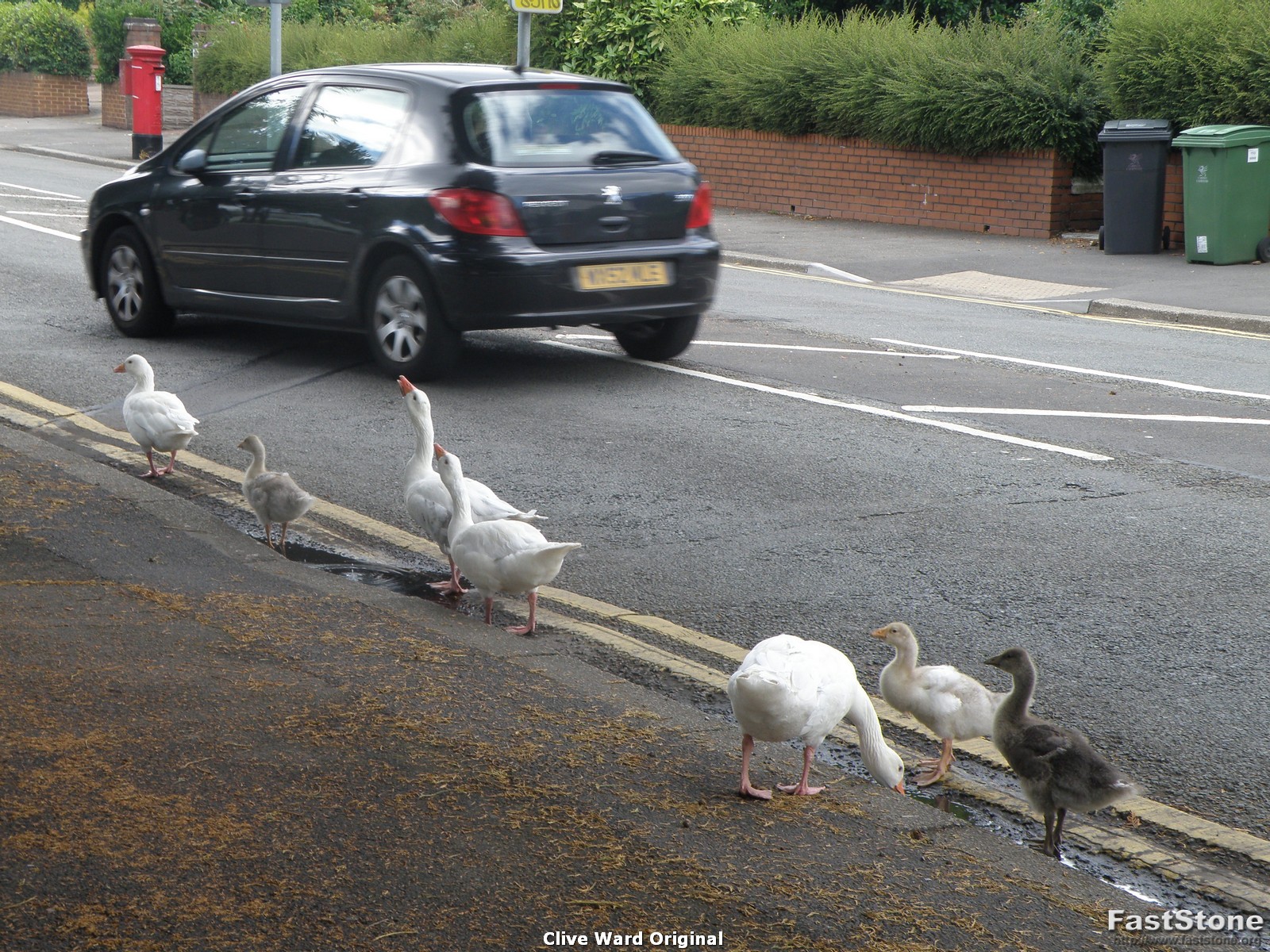
It seems when there has been fresh rain, the fresh rain water seems a better option for the geese than the water to be found in the lake!


This week the weather brought regular down pours and this week I saw the young gosling leading the way to the road side to drink from the water laying along the road sides.


It can be seen how dangerous it is for passing motorists!!


Has anyone seen this behaviour in other places?


A Coot Encounter with a grebe on the nest under the willow!


This young Coot who was from the first clutch to be incubated and is about seven weeks old does not have the same sort of problems as the gosling ... he has own bottle (is it Brains SA maybe) at his ready disposal!!


At the beginning of this week the parents hatched out their second brood of young!!


The only problem was under that particular willow there were two nests one belonging to the coots and in close proximity was a grebes nest ...... and unfortunately the young coot did not yet recognise its parents plumage!!


the coot chick edged its way up to the grebes nest. The Grebe initially was quite tolerant but as the the little un continued to seek attention the grebe became agitated and rose from the eggs and commenced pecking at the little innocent coot!!


..... within seconds the parent coots came racing across the water like athletes and it was quite difficult to see who ended up under the water as the water splashed up reflecting the ferocity of the battle


..... the Grebe came out of it with its feathers fluffed out round its head and the tiny coot made its escape!!


In the painting below I have created a composite illustration of the stages of the action, it may seem all a little confusing but that reflects the action itself ... ferocious but over in an instant as the grebe returned to the job in hand incubating those eggs!!


Tuesday, 6 July 2010

An unusual Encounter

I had spent most of the week at Rowen and on the Friday the cloud was blowing in off of the coast and the mountain tops were covered by wisps of cloud blowing across.

Throughout the week I had seen many Buzzards gliding on the rising warm air, often in pairs. On my previous walk up this way earlier in the week I had seen a pair of Buzzards being mobbed by a pair of crows. In the rocks there were many crows.


I had stopped and made a sketch of a stone chat as it flew between branch and rock chanting its chat chat continually making me wonder if it was guarding a nest.


I followed paths often mistaking sheep tracks to St Celynin Church, a small 12 century chapel which I remembered often visiting on walks from Penmaenmawr. Today I was following a route from the youth hostel and was planning to head towards Conwy. This route followed a lane which wound its way down between stone boundary walls and thick woodland. I was making good progress and was some what mesmerised by the heat, the setting and was only quite distantly aware of the sound of bird making quite a commotion in the trees above me.
I thought nothing more of it!
I was planning to walk around the far side of the river Conwy and back to Rowen. It was to be long walk!


I was totally unaware that the screeching bird(s) above were showing concern at my presence .... until quite suddenly as I was walking through quite an enclosed area of woodland I had a thump on the back of my head, which thankfully was protected by my leather hat! Momentarily I was stunned ... what ever was it .... then I saw a bird a little ahead of me flying at my height as it flew up onto a branch above. At first glance it looked like an owl.


as I investigated and taking photos with my camera, I became aware of the birds quite massive talons.
...... it was quite obvious the bird had not got the result it had hoped for and it circled in round quite close again .... I believe my saving grace was the fact that the lane was so enclosed by trees that instead of swiping me for a second time the bird perched again on another branch.


I quickly got another couple of shots but realised this bird was really not happy at my presence and quickly descended down the lane warily looking out for anymore low flying birds!


Once at a safe distance I made a quick sketch of my close encounter!


This is a view looking back up the lane and to the upland location of the old church. In those trees I had an encountered quite an unusual with a bird of prey, quite poignant when one has regularly demonstrated the stoop of the peregrine to visitors to the RSPB project in Cardiff.


The following day I returned to the location with my friend Rob and there was little sign of the birds initially, however after a short time the two birds were circling above the trees. Even with the birds just circling i was keen to make an exit, which Rob noted with some surprise!! There was no commotion as the day before. I can only assume the previous day, the bird had seen me descending from way back at the old church and by the time I reached the area of the trees where the buzzard probably had its nest or where a chick was fledging. Therefore, it was threatened and defending its young went into action, catching me totally unaware!


The high trees .... probably the site of the Buzzards nest, which accounts for the aggressive nature of the bird.
Since returning home I have researched similar incidents on the Internet to find there were several reported incidents in 2009 where the Buzzard had actually caused loss of blood and in several occasions made more than one attack on the Innocent passerby. Newspaper reports also suggest that Buzzards have been known to attack cyclists, wearing helmets in a similar way, and will even do damage to car aerials as they pass!
I sensed I had been fortunate to have been able to see the funny side of the encounter with the bird and have made painted a self portrait to record the event!


Self Portrait: Clive quite unaware of approaching Buzzard.

Tuesday, 22 June 2010

Majestic Snowdonia


The splendour of Snowdonia ... an Introduction


I have just spent a week or so enjoying the delights of Snowdonia from the magnificent mountain tops, to the Cwms and hanging valleys remnants left as the ice retreated after the last ice age to the vast sandy estuaries and cliffs that form the North Wales coastline. All offer a wide variety of wild life habitats.


This is a place I have a long appreciation of from our early family holidays we had both enjoying the beach often looking at Puffin Island with the sun setting over it after having spent a day exploring the mountains on foot. discovering Snowdonias hidden haunts as we followed walks from various points on the railway.


In future postings i will be looking at some of these places such as Cwm Ogwen at the head of the Nant Francon Valley and surrounded by the peaks of the Glyers, the Devils Kitchen a famous landmark for walkers and climbers is the centre of a anti-cycline fold in these ancient rocks


Postings will spot light a variety of settings which offer a variety of flora and fauna


Below can be seen Aber Falls, the falls locate the position of a hanging valley, formed in the glacial period.


In contrast will be the spot light on coastal features, the picture to the left shows Eider Duck on rocks at high tide at Aber Ogwen which lies directly across the Menai Straits from Beaumaris where I was to take a boat trip out to view the sea birds nesting on Puffin Island.


The mysterious Island, of Puffin Island, laying off of Eastern Anglesey: two contrasting views as seen from Aber Ogwen as the tide goes out and from the head of Great Orme as the feral goats munch grass.


The variety of terrains offers the opportunity to see and watch a large variety of birds from the many sea birds who make nest in the rocky cliffs on the promontories that make up this coastline to the birds that prey that live of the mammals that this terrain offer, from Osprey who hunt fish from the vast waters to the Buzzard who eats rodents and small animals. On many of my mountainside walks I was to see pairs of Buzzard, as shown in the water colour above painted on location on a footpath leading up from Rowen Youth Hostel where I was camping, with fox gloves growing between the rocks as the fields with their stone wall surrounds gave way to views across the Conwy Valley to Llanwrst and beyond. On the hillsides were to be found many small flocks of crows who could be often seen mobbing the much bigger Buzzard! Little did I know that I was going to have my own encounter with these birds ... stay tuned to hear and see more!!!


I will also be continuing to follow the birds to be found in Cardiff as I return.


Tuesday, 8 June 2010

... Comparing how young birds find their way and are parented


Under the willow ... life as young Great Crested Grebe


At times the coots have been arch rivals but other than the odd time when the parent grebe senses danger and sends out her warning call, opening wide her beak and extending her crest the two families seem to share the willow as it offers safety tor both from predators. But at times of trouble the coot family return to their nest, but the Grebes abandoned their nest long ago and the place of security for the young grebe is in the feathers of the parents back. Grebes never go ashore the closest they do so is to go on their floating nests while incubating the eggs.


The Grebe seems to be a very shy bird and hides and cowers away but I have of people saying the parent will attack predators with fury, but it is not something i have witnessed.


In comparison the coots are quite social sticking together as a group, while the grebe is left with her chick sheltering and male seems to return to feed or to escort his family to a different place of shelter and safety.

The young grebe seems to spend much time in the protection of the parents back, but maybe it is not so surprising they have already lost two chicks, one since Saturday. The survival of chicks was far better last summer.


Life on the back ... what a life!


When it is snack time for the young grebe

The second parent either seems to come with food caught from diving or as was this case took the family out into the open water so I was able to get the photos below.


The young Starling also has to call out and follow the parent who catches relevant bits which is then put straight into the open beak of the young bird.


While the signets idle about in the water before returning to the bank while the cob with his feathers puffed up goes off in pursuit of any other swans that dare to come to close ..... even across the other side of the lake!!


It may seem to be the ugly duckling in its own eyes but the signet seems to have a confident start although like others they are open to predators particularly in their first week. This pair who have been rearing for a number of years now at Roath seem to work well in partnership keeping a close eye on their Young and their territory!


On occasions the resident black swans, a non native to these waters it has been said attack the young mute signets. I have not seen this but seeing their aggressiveness towards the mute swan in other situations ... see other earlier posting, I can quite believe it!.


Take another Bird that starts life in South Wales


Quite by Contrast the Storm Petrel, which in some ways is not dis-similar to the grebe in that it remains on water other than coming ashore to nest and lay eggs. The storm petrel comes to remote locations off the British and Scandinavian coast for this purpose, including the South Wales coast. The young storm petrel then has to find its own way migrating back to the waters off South Africa for the winter.


A project ran by Cardiff University and A Rosha Portugal has been studying the migration patterns of this small seabird and looking to link changes in weight and diet to see if it correlates to changes in temperature and thus ultimately climate change.


The work is carried out at night on cliffs on the Algarve Coast of Portugal, where the birds are caught in nets, first ringed and then weights and feces samples taken (if the birds cooperate) before being released again.


I volunteered on one of the teams last year. The project is currently on location at the Algarve just now. From all accounts it appears they are getting few birds coming into the nets which must be making the nights sitting anticipating the birds coming in long and tedious.


You can watch the projects progress by going to: http://stormies-online.blogspot.com/


This was a water colour painting I created as I anticipated working on the project with the stormies coming into the nets as a result of playing recordings of their bird song.